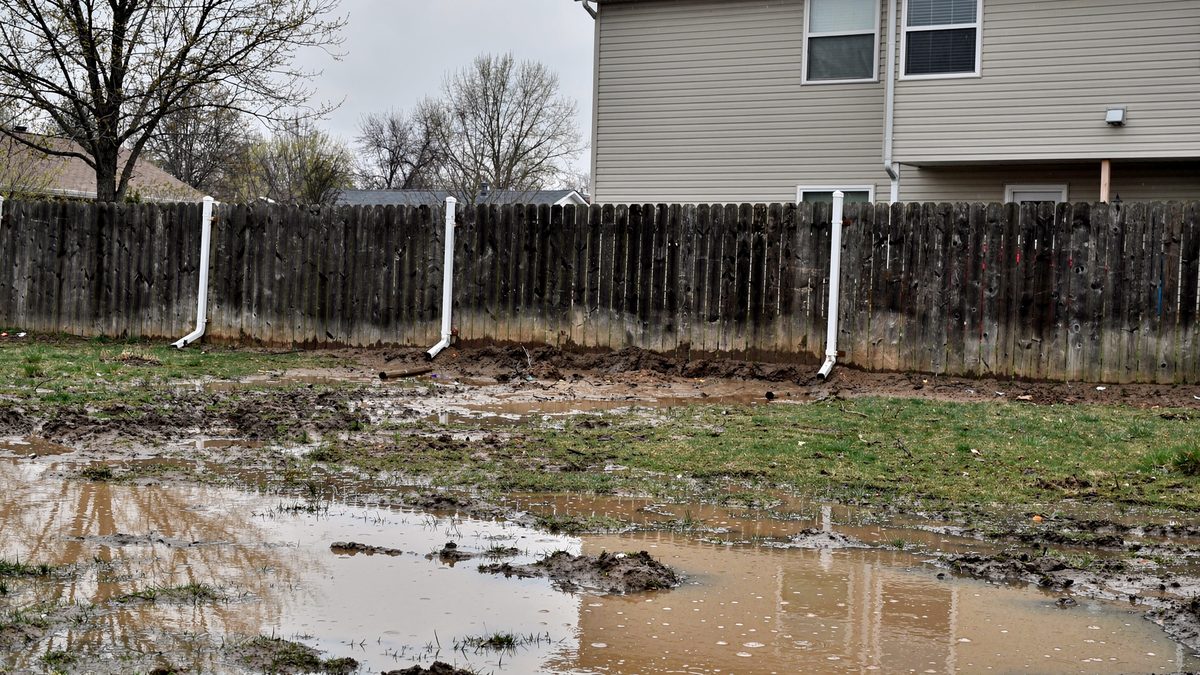
Standing Water Is a Grade Problem Until Proven Otherwise
Most calls about a swampy yard turn out to be about fall, not soil. Water needs somewhere lower to go, and on a lot where the builder's original grading has settled over twenty or thirty years, the lower place is often now the middle of the lawn. We shoot grades before proposing anything.
A quarter inch of fall per foot, recovered by regrading, solves problems a drain would only manage.
Where soil genuinely is the constraint, it is usually the high-clay uplands. Sharpsburg and Grundy on the Kansas side and the clay and shale soils on the Missouri side hold water at the surface long after a sandier profile would have drained, which is why the same rainfall produces a two-day puddle on one street and nothing on the next.
What a Yard Drainage System Includes
Catch basins at the low points, solid pipe carrying collected water to an outlet, regrading to move surface water toward those basins rather than toward the house, and where appropriate a swale to intercept water crossing the lot before it reaches anything you care about. On lots with real fall, a swale alone sometimes does the entire job for a fraction of a piped system.
What we do not do is install a system that dumps a neighbor's problem onto them. In Overland Park that is codified, with sump discharge required five feet off any property line and constant discharge onto a sidewalk abatable as a nuisance, but it is the right approach everywhere.
Pricing and Scope
Typical residential yard drainage projects run quoted from a written scope. The variables are the area being drained, how many collection points it needs, the distance to a workable outlet, and how much regrading and sod restoration is involved. A single low corner with a basin and a short run to daylight sits at the bottom of that range; a full rear yard with multiple basins and a long carry sits near the top.
Every proposal states the collection points, the pipe route, the outlet and the restoration. If the honest answer is that regrading alone will fix it, that is the proposal you get.
Timing the Work
The best time to assess a drainage problem is during or just after a heavy rain, when the water is visible. If you can, photograph or video the standing water before it drains and send it with your call. That single piece of evidence is worth more than anything we can infer from a dry lot in August.
Spring is when Kansas City soils are at their wettest, and it is when the seasonal perched water table sits highest in the Johnson County clays. A system designed on a July site visit can be undersized for April conditions, which is why we ask what the yard does in spring even when we are standing in it in summer.
Yard Drainage Available In
- Kansas City, MO Jackson County, Missouri
- Overland Park, KS Johnson County, Kansas
- Olathe, KS Johnson County, Kansas
- Lee's Summit, MO Jackson County, Missouri
- Independence, MO Jackson County, Missouri
Drainage Questions, Answered
- How long should water stand in my yard after rain?
- Hours, not days. Water still standing a day or two after the rain stopped indicates either no fall to an outlet or a soil profile that will not accept it, and those need different fixes.
- Can I just add topsoil to fill the low spot?
- Occasionally, on a small depression with fall available nearby. More often it moves the puddle rather than removing it, because the water still has nowhere lower to go.
- Will drainage work kill my grass?
- The trench line is disturbed and gets restored. We quote the restoration as part of the scope rather than leaving you with a scar and a separate landscaping bill.